Work, Energy and Power Class 11 Physics Quick Recall Sheet (Short Notes 2026-27)
Ayush (Founder)
Exam Strategist
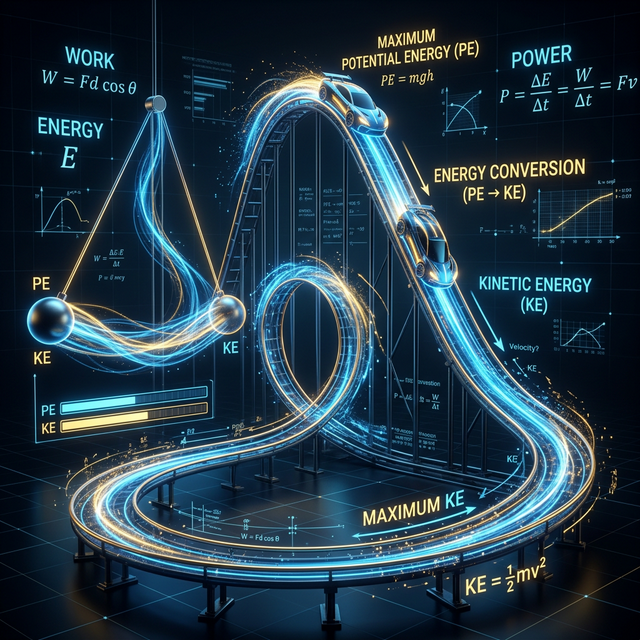
[!TIP] 🚀 2-Minute Quick Recall Summary (Save for Exam Day)
- Work: W = Fd cosθ. Work done by constant force = area under F-x graph.
- Work-Energy Theorem: Work done by all forces = Change in Kinetic Energy (ΔK).
- Potential Energy: Gravitational U = mgh; Spring U = ½kx².
- Power: P = ΔW/Δt = F · v. Unit: Watt (W).
- Collisions: Linear momentum is always conserved. Elastic collision: K.E. is also conserved. 📥 Download 1-Page Short Notes PDF (Zero-Friction)
Introduction
While forces describe the "how" of motion, Energy and Work describe the "capability" of a system to undergo change. This chapter introduces the scalar approach to Mechanics, which often simplifies complex vector problems into straightforward energy balances. Whether we are analyzing the energy stored in a compressed spring or the impact of a high-speed collision, the rules of Work and Energy are universal. In this "Comprehensive" guide, we provide exhaustive derivations for the Work-Energy Theorem, Spring Potential Energy, and Power formulas, as well as a deep dive into the mechanics of elastic and inelastic collisions for JEE and NEET excellence.
1. Work: The Transfer of Energy
In physics, Work (W) is done only when a force causes a displacement. Formula: W = F · d = Fd cosθ
- Unit: Joule (J).
- Dimension: [ML²T⁻²].
Three Face of Work:
- Positive Work (θ < 90°): Force and displacement are in the same direction (e.g., Kicking a ball).
- Negative Work (θ > 90°): Force opposes displacement (e.g., Friction, Braking).
- Zero Work (θ = 90°): Force is perpendicular (e.g., Work done by gravity on a person walking horizontally).
2. The Work-Energy Theorem (WE Theorem)
Theorem: The work done by the net force on an object is equal to the change in its kinetic energy. Work_net = ΔK = K_final - K_initial
Derivation (For Variable Force):
- Work (W) = ∫ F dx.
- From Newton's Second Law: F = ma = m (dv/dt).
- Using chain rule: a = (dv/dx)(dx/dt) = v (dv/dx).
- Substitute F: W = ∫ [m v (dv/dx)] dx = ∫ m v dv.
- Integrating from initial velocity u to final v:
- W = m [v²/2]ᵤᵛ
- W = 1/2 mv² - 1/2 mu². (Proven)
3. Kinetic and Potential Energy
I. Kinetic Energy (K)
The energy possessed by an object due to its motion. Derivation: K = 1/2 mv². (As shown in the WE theorem above).
II. Potential Energy (U)
The "stored" energy due to an object’s position or configuration in a conservative field.
- Gravitational Potential Energy: U = mgh (for small heights h ≪ R).
III. Derivation: Potential Energy of a Spring
- The restoring force of a spring is F = -kx (Hooke’s Law).
- Work done dW = -F dx = kx dx.
- Integrating from 0 to extension x:
- W = ∫ [0 to x] kx dx = [1/2 kx²]₀ˣ
- U = 1/2 kx². (Proven)
4. Conservation of Mechanical Energy
Theorem: In the presence of only conservative forces, the total mechanical energy (K + U) of a system remains constant. Proof (Free Fall): At height H: K=0, U=mgH. Total = mgH. At descent height x: v² = 2gx. K = 1/2 m(2gx) = mgx. U = mg(H-x). Total = mgH. Result: Total energy is constant at every point in the flight.
5. Power: The Rate of Work
Power (P) is the rate at which work is performed. Derivation:
- P = dW / dt.
- Since dW = F · dx:
- P = (F · dx) / dt = F · (dx/dt).
- Result: P = F · v.
- Unit: Watt (W). 1 horsepower (hp) = 746 W.
6. Collisions: Momentum Meets Energy
I. Elastic Collision (1D)
- Both Momentum and Kinetic Energy are conserved.
- Coefficient of Restitution (e) = 1.
II. Inelastic Collision
- Only Momentum is conserved; some K.E. is lost (as heat/sound).
- Perfectly Inelastic: Objects stick together after impact (e = 0).
Comprehensive Exam Strategy (Q&A)
Q1: Can Kinetic Energy ever be negative? Answer: No. K = 1/2 m v². Since mass is always positive and v² is always positive (or zero), kinetic energy is always ≥ 0.
Q2: What happens to the potential energy when a spring is compressed vs. stretched? Answer: In both cases, Potential Energy increases. Because U = 1/2 kx², squaring the displacement (x) always yields a positive value, meaning the system stores energy whether it's compressed or stretched.
Q3: A ball is dropped from a height. If it bounces back perfectly, is it an elastic collision? Answer: Ideally, yes. If the ball reaches the exact same height from which it was dropped, then e = 1 and no energy was lost during the impact with the ground.
Related Revision Notes
- Chapter 4: Laws of Motion (Momentum Concepts)
- Chapter 6: System of Particles & Rotational Motion
- Mastering Collision Physics: Numerical Vault
Conclusion
Energy is the invisible currency of the universe. By shifting our perspective from forces (vectors) to energy (scalars), we unlock a simpler, more powerful way to solve complex physical problems. Master the Work-Energy Theorem and the conservation of mechanical energy—these are the laws that ensure the bridge stands, the rocket launches, and the universe keeps moving. Stay energetic, work with purpose, and always conserve your potential!
Reference: Journal of Energy and Power Technology