JEE Mains High Weightage Low Effort Chapters 2026 Guide
Ayush (Founder)
Exam Strategist
If you're a JEE aspirant, you've probably heard the advice: "Complete the entire syllabus." I'm here to tell you that’s a lie. In a 3-hour exam with a 300-mark ceiling, trying to master everything is the fastest way to master nothing.
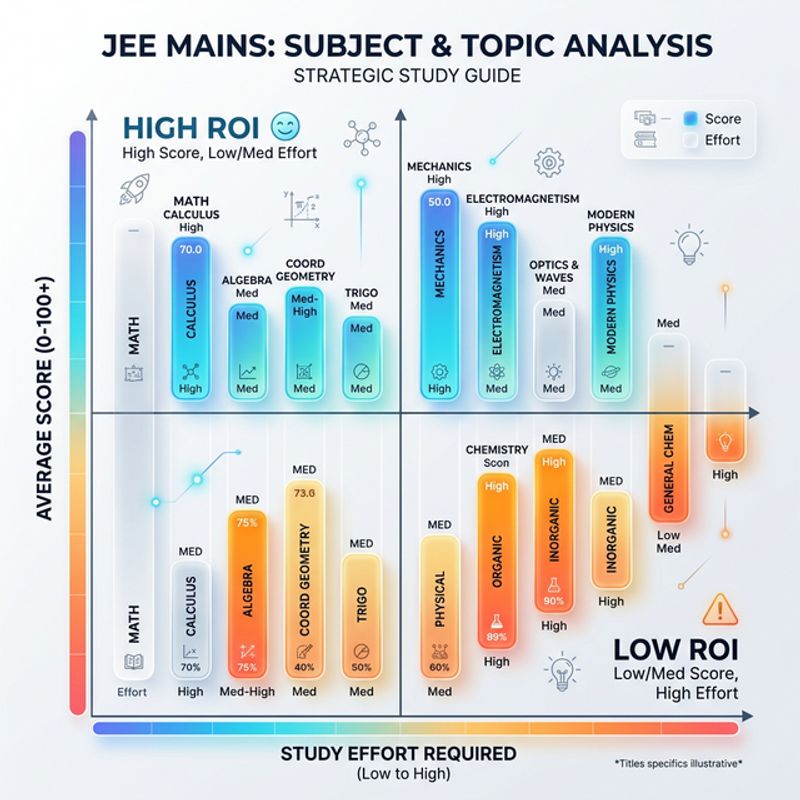
I’m Ayush, and after spending years analyzing thousands of previous year papers while building Exam Compass, I discovered a pattern. Roughly 40% of the JEE Mains paper comes from "High-ROI" chapters—topics that take very little time to study but yield massive marks.
In this guide, I’m sharing the exact list of JEE Mains high weightage low effort chapters for 2026 so you can stop studying harder and start studying smarter.
Key Takeaways
- The 80/20 Rule: 80% of your marks come from 20% of the syllabus.
- Modern Physics: The undisputed king of ROI in Physics.
- Inorganic Trio: Why you can score 40+ marks in Chemistry with just NCERT.
- Math Reasoning: 4 marks for the cost of 2 hours of study.
- Active Analysis: Use an online mock test to see your accuracy in these specific zones.
Table of Contents
- The Philosophy of High-ROI Preparation
- Physics and Chemistry: The Formula Goldmines
- Mathematics: High-Yield Strategic Chapters
- Effort vs. Marks: A Tactical Comparison
- Conclusion
- Frequently Asked Questions (FAQs)
The Philosophy of High-ROI Preparation
The JEE syllabus includes roughly 90 chapters. Trying to master all of them in a short timeframe is often counterproductive. Top scorers at IITs succeed because they know what to skip. They focus on trends in previous year papers to maintain a balance between difficulty and accuracy.
Exam conductors like the NTA include "easy" chapters like Units and Dimensions to balance the paper. These JEE Mains high weightage low effort chapters are low-hanging fruits that yield high marks for minimal effort. According to U.S. News Education, focusing on high-ROI tasks is a proven strategy for high-stakes examinations.
Physics and Chemistry: The Formula Goldmines
In Physics, "Modern Physics" is the undisputed king of ROI. It covers Dual Nature, Atoms, and Nuclei, often providing up to 16 marks for just a few hours of study. Similarly, Semiconductors and Communication Systems offer binary results—either you know the logic gate or you don't—without requiring complex calculations.
Chemistry is where you secure your rank. Chapters like Environmental Chemistry and Biomolecules take very little time to master using NCERT solutions. By reading these "memory-based" chapters a week before the exam, you ensure the information is fresh and ready for immediate retrieval during the test.
Mathematics: High-Yield Strategic Chapters
JEE Math has become increasingly lengthy, but you can still find strategic wins. Mathematical Reasoning and Statistics are "safe" chapters that can be mastered in a single afternoon. These provide 8 marks through simple formula application and truth tables, yet many students overlook them.
Vector and 3D Geometry is another heavyweight unit. Unlike Calculus, it doesn't require creative "flair"—it requires visualization and systematic formula application. Mastering these ensures you have a solid "floor" for your Math score, allowing you to tackle tougher problems with reduced pressure.
Effort vs. Marks: A Tactical Comparison
A tactical approach involves comparing study time to potential marks. For instance, Rotational Motion might take 20 hours for 4 marks (Low ROI), while Mathematical Reasoning takes 2 hours for 4 marks (Extreme ROI). High-ROI chapters should always be your first priority during revision.
Most coaching centers won't tell you to skip chapters because they've sold a "complete" course. However, you only need around 180 marks for a top NIT. That means you can afford to leave 30% of the hardest questions entirely. Use online mock tests to validate this strategy and focus on "owning" the high-weightage topics.
Conclusion
Success in JEE Mains 2026 depends on your ability to prioritize high-yield chapters over a "complete but shallow" syllabus coverage. By mastering the Sniper Strategy, you can maximize your marks with optimized effort. Combine these high-ROI topics with disciplined practice and regular online mock tests to secure your seat in an elite institution.
Explore our Sitemap for more resources.
Frequently Asked Questions (FAQs)
1. Can I clear JEE Mains by only studying high-weightage chapters?
Yes, for qualification purposes. However, to secure a top rank in an NIT or qualify for JEE Advanced, you should aim for 70–80% of the syllabus, always starting with these high-ROI chapters to build a solid scoring base.
2. Is Rotational Dynamics a low-ROI chapter?
Mathematically, yes. It takes significant time to master and usually yields only 1–2 questions. While it helps with overall Physics intuition, it should not be your priority if you are short on preparation time.
3. Which subject is the easiest to score in?
Chemistry is statistically the easiest and most scorable. Many questions are direct or semi-direct from NCERT. If you know the concept, you get the marks quickly, leaving more time for the calculations required in Physics and Math. become your strongest area.