Units and Measurement Class 11 Physics Quick Recall / Short Notes (2026-27)
Ayush (Founder)
Exam Strategist
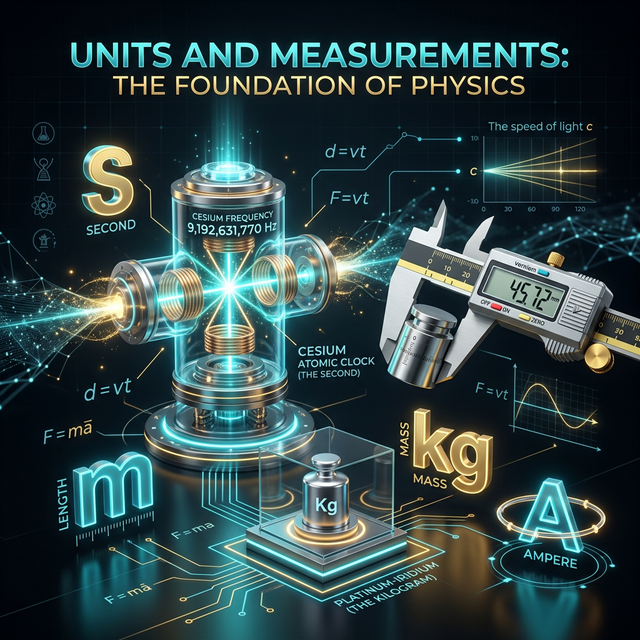
[!TIP] 🚀 2-Minute Quick Recall Summary (Save for Exam Day)
- Fundamental Quantities: Length (m), Mass (kg), Time (s), Current (A), Temp (K), Amount (mol), Intensity (cd).
- Dimensional Analysis: Used to check formula correctness (LHS = RHS) and derive relations.
- Significant Figures: Zeros between non-zeros are sig; trailing zeros after decimal are sig.
- Error Propagation: Δ(A+B) = ΔA + ΔB; Relative Error in multiplication/division is constant: ΔZ/Z = ΔA/A + ΔB/B.
- Parallax Method: Used for astronomical distances: D = b / θ. 📥 Download 1-Page Short Notes PDF (Zero-Friction)
Introduction
Measurement is the cornerstone of all experimental and theoretical sciences. Physics is an exact science that relies on the precise quantification of physical phenomena. Whether we are probing the subatomic scale of a proton or the cosmic scale of a galaxy, we need a robust, standardized system of units and a rigorous understanding of measurement errors. These "Comprehensive" revision notes provide more than just a summary—they offer deep theoretical insights, mathematical proofs for error propagation, and advanced applications of dimensional analysis. Mastering this chapter is the first step toward becoming a world-class physicist.
1. The International System of Units (SI)
In 1971, the General Conference on Weights and Measures (CGPM) established the SI system as the international standard. It is a coherent system where all derived units are obtained by multiplying or dividing base units without any numerical factors other than unity.
The Seven Pillars:
- Length (Metre, m): Defined by the distance light travels in a vacuum in 1/299,792,458 of a second.
- Mass (Kilogram, kg): Defined by fixing the numerical value of the Planck constant h to be 6.62607015 × 10⁻³⁴ J·s.
- Time (Second, s): Defined by the frequency of radiation from the transition between hyperfine levels of the ground state of the Cesium-133 atom.
- Electric Current (Ampere, A): Defined by the elementary charge e.
- Thermodynamic Temperature (Kelvin, K): Defined by the Boltzmann constant k.
- Amount of Substance (Mole, mol): Contains exactly 6.02214076 × 10²³ elementary entities (Avogadro number).
- Luminous Intensity (Candela, cd): Measures the perceived power of light.
Supplementary Units:
- Plane Angle (θ): Measured in Radian (rad). θ = Arc / Radius.
- Solid Angle (Ω): Measured in Steradian (sr). Ω = Area / Radius².
2. Dimensional Analysis: Theorems and Derivations
"Dimension" refers to the physical nature of a quantity, regardless of the system of units used.
The Principle of Homogeneity of Dimensions
Theorem: A physical equation is only correct if the dimensions of all terms on both sides of the equation are identical. Mathematical Representation: If X = Y + Z, then [X] = [Y] = [Z].
Advanced Application: Deriving Physical Relationships
We can derive a physical formula if we know the dependencies between variables.
Derivation Example: Time Period of a Simple Pendulum Let the time period T depend on mass of the bob m, length of the string l, and acceleration due to gravity g.
- Assume T ∝ mᵃ lᵇ gᶜ => T = k mᵃ lᵇ gᶜ (where k is a constant).
- Substitute dimensions: [T¹] = [M]ᵃ [L]ᵇ [LT⁻²]ᶜ
- Compare powers:
- For M: a = 0
- For L: b + c = 0 => b = -c
- For T: -2c = 1 => c = -1/2
- Therefore, b = 1/2.
- Result: T = k √(l/g). (Experimental value: k = 2π).
3. Error Analysis: Mathematical Proofs
No measurement is 100% accurate. We must understand how errors "propagate" when calculating derived quantities.
I. Proof: Error in a Sum or Difference
Let Z = A + B. Let ΔA and ΔB be absolute errors. Z ± ΔZ = (A ± ΔA) + (B ± ΔB) Z ± ΔZ = (A + B) ± (ΔA + ΔB) Since Z = A + B, then ΔZ = ΔA + ΔB. Theorem: For both sum and difference, the absolute errors always add up.
II. Proof: Error in a Product or Quotient
Let Z = AB. Taking natural logarithms on both sides: ln Z = ln A + ln B Differentiating: dZ/Z = dA/A + dB/B Replacing differentials with small errors: ΔZ/Z = ΔA/A + ΔB/B Theorem: When multiplying or dividing, the Relative Errors add up.
III. Proof: Error in a Power
Let Z = Aⁿ. ln Z = n ln A Differentiating: dZ/Z = n (dA/A) Therefore: ΔZ/Z = n (ΔA/A). Conclusion: The power becomes a multiplier for the relative error.
4. Measurement of Space and Time
The Parallax Method (For Interstellar Distances)
Principle: When an object is viewed from two different positions (Basis, b), it appears to shift against a distant background. Formula: θ = b / D
- θ: Parallax angle in radians.
- D: Distance to the celestial body.
- By measuring θ and knowing b, we calculate D = b / θ.
5. Significant Figures & Rounding Rules
Scientific accuracy is reflected in the number of significant digits used.
- Rule of Operation: In multiplication/division, the result should have significant figures equal to the quantity with the least significant figures.
- Rounding Theorem:
- If the dropped digit is > 5, increase preceding by 1.
- If it is 5 followed by non-zeros, increase preceding by 1.
- Even-Odd Rule: If it is exactly 5 (or 5 followed by zeros), the preceding digit is increased if odd, and left alone if even.
Comprehensive Exam Strategy (Q&A)
Q1: Prove that the formula for Kinetic Energy (K = 1/2 mv²) is dimensionally correct. Answer:
- LHS: [K] = [M¹ L² T⁻²].
- RHS: [1/2 m v²]. Constants like 1/2 are dimensionless.
- [m] = [M¹], [v] = [L T⁻¹].
- [m v²] = [M¹] [L T⁻¹]² = [M¹ L² T⁻²].
- Conclusion: LHS = RHS. The formula is dimensionally correct.
Q2: A physical quantity is given by P = a³b² / √c. Calculate the maximum percentage error in P. Answer: Using the Error in Power Theorem: %ΔP = 3(%Δa) + 2(%Δb) + 1/2(%Δc) This is the standard approach for competitive exams like JEE Main.
Q3: Why can't we use Dimensional Analysis to find the value of constants like '2π' in the pendulum formula? Answer: Dimensional analysis only tracks the "nature" of dimensions (Mass, Length, Time). Since numerical constants are just numbers, they contribute [M⁰ L⁰ T⁰] and are invisible to dimensional calculations.
Related Revision Notes
- Chapter 2: Motion in a Straight Line (Kinematics)
- Chapter 3: Motion in a Plane (Vectors)
- Advanced Error Analysis Calculator
Conclusion
Units and Measurements are not just "entry-level" topics; they are the filter through which all physical truth must pass. By mastering the mathematical proofs of error propagation and the power of dimensional analysis, you move from merely memorizing formulas to understanding the underlying logic of Physics. Stay precise, keep your dimensions balanced, and minimize your errors!
Reference: BIPM: The International System of Units