States of Matter — Gas Laws & Real Gas Deviations JEE NEET 2026 Tricks
Ayush (Founder)
Exam Strategist
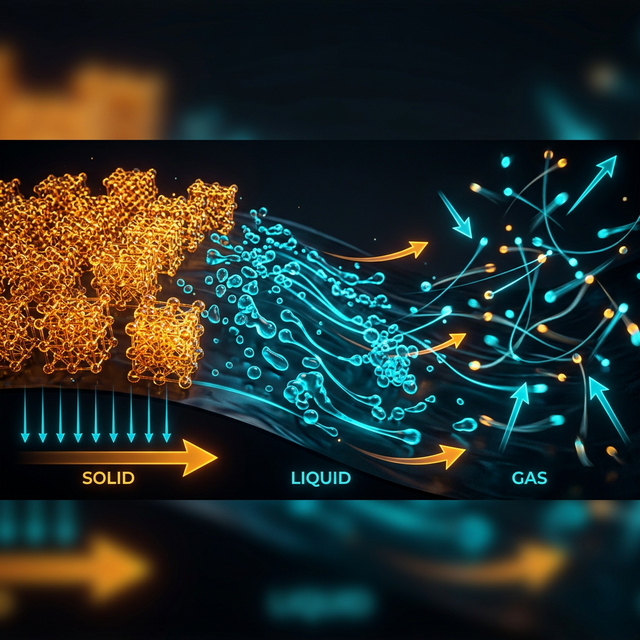
Table of Contents
- Why States of Matter is Your "Physics in Chemistry" Chapter
- Intermolecular Forces: The Root Cause of Physical States
- Boyle's, Charles's, and Gay Lussac's Laws — The Foundation
- The Ideal Gas Equation: Combining Everything ()
- Dalton's Law & Graham's Law: Mixtures and Diffusion
- Kinetic Molecular Theory (KMT): The Microscopic View
- Real Gases vs Ideal Gases: When Reality Breaks the Rules
- The van der Waals Equation: Correcting for Reality
- Critical Temperature, Boyle Temperature, and Liquefaction
- The "Trap" Section: Gas Law Pitfalls
- Practice MCQs (JEE/NEET Level)
- Ayush's Gas Laws Strategy
1. Why States of Matter is Your "Physics in Chemistry" Chapter
States of Matter describes how the physical behavior of substances (particularly gases) is governed by temperature, pressure, and volume, and how these variables interact through mathematical laws.
This chapter is where Physics and Chemistry merge. If you're comfortable with Thermodynamics and Kinetic Energy in Physics, you'll fly through this. The key challenge isn't the concepts — it's the unit conversions. I've seen students who understand Boyle's Law perfectly but get 0 marks because they forgot to convert Celsius to Kelvin.
Why This Chapter Matters (Exam Data)
- JEE Mains 2025 Session 1: 1 question on Compressibility Factor () and 1 on Graham's Law.
- NEET 2024: 1 question on van der Waals constants and liquefaction ease.
- CBSE Boards: This unit carries 4-5 marks and is often paired with Thermodynamics in the paper.
2. Intermolecular Forces: The Root Cause of Physical States
Intermolecular Forces (IMFs) are the attractive and repulsive forces between molecules that determine the physical state (solid, liquid, gas) and properties (boiling point, viscosity) of a substance.
| Type | Strength | Between | Example |
|---|---|---|---|
| Ion-Dipole | Strongest | Ion + Polar molecule | in |
| H-Bonding | Strong | H bonded to F, O, N | , HF |
| Dipole-Dipole | Moderate | Polar + Polar | , |
| Dipole-Induced Dipole | Weak | Polar + Non-polar | |
| London Dispersion | Weakest | Non-polar + Non-polar | , |
3. Boyle's, Charles's, and Gay Lussac's Laws — The Foundation
Gas Laws are empirical relationships that describe the behavior of an ideal gas by relating its pressure, volume, and temperature.
Boyle's Law (Constant T)
. The P-V graph is a hyperbola (isotherm).
Charles's Law (Constant P)
. Temperature MUST be in Kelvin. The V-T graph is a straight line through the origin when plotted in Kelvin.
Gay Lussac's Law (Constant V)
. The P-T graph is a straight line (isochore).
Avogadro's Law (Constant T, P)
. Equal volumes of all gases at same T and P contain equal number of molecules.
Ayush's Note — The Celsius Catastrophe
The Mistake: In my 2nd mock test, I used directly in Charles's Law instead of converting to . The Fix: Now, the FIRST thing I write on my rough sheet for ANY gas problem is: . It takes 2 seconds and saves 4 marks.
4. The Ideal Gas Equation: Combining Everything ()
The Ideal Gas Equation () is a single equation that combines Boyle's, Charles's, and Avogadro's laws to describe the state of a hypothetical "ideal" gas.
Value of R (Gas Constant)
| Value | Units | When to use |
|---|---|---|
| SI units (P in Pa, V in m³) | ||
| P in atm, V in Liters | ||
| Energy in calories |
The Density Shortcut
From and : where = density. This is a high-yield JEE formula for "find the molar mass of a gas" questions.
5. Dalton's Law & Graham's Law: Mixtures and Diffusion
Dalton's Law of Partial Pressures states that the total pressure of a mixture of non-reacting gases is equal to the sum of individual partial pressures of each component gas.
where = mole fraction.
Graham's Law of Diffusion
Graham's Law states that the rate of diffusion or effusion of a gas is inversely proportional to the square root of its molar mass.
JEE Trick: This means lighter gases diffuse faster. diffuses 4× faster than (since ).
6. Kinetic Molecular Theory (KMT): The Microscopic View
The Kinetic Molecular Theory explains the macroscopic properties of gases (P, V, T) in terms of the microscopic behavior (motion, collisions, kinetic energy) of individual gas molecules.
Core Postulates
- Gas molecules have negligible volume compared to the total container volume.
- Molecules are in constant, random motion in all directions.
- Collisions between molecules and container walls are perfectly elastic (no energy loss).
- There are no intermolecular forces of attraction or repulsion.
- Average Kinetic Energy is proportional to temperature: (per molecule) or (per mole).
Molecular Speeds (JEE Advanced)
| Speed | Symbol | Formula | Relative Value |
|---|---|---|---|
| RMS Speed | 1.73 | ||
| Average Speed | 1.59 | ||
| Most Probable Speed | 1.41 |
Ratio: .
7. Real Gases vs Ideal Gases: When Reality Breaks the Rules
Real Gases are actual gases that deviate from ideal gas behavior due to intermolecular attractions and the finite volume of gas molecules.
The Compressibility Factor (Z)
| Z Value | Meaning | Dominant Force | Condition |
|---|---|---|---|
| Ideal behavior | None dominating | Low P, High T | |
| Easier to compress | Attractive forces | Moderate P | |
| Harder to compress | Repulsive forces | Very High P |
Key Insight: For and , is always because their molecules are so small that attractive forces are negligible. Only repulsive forces matter.
8. The van der Waals Equation: Correcting for Reality
The van der Waals Equation is a modified form of the ideal gas equation that accounts for the finite size of molecules (volume correction 'b') and intermolecular attractions (pressure correction 'a').
| Constant | Meaning | Higher value means |
|---|---|---|
| a | Attraction between molecules | Easier to liquefy ( > > ) |
| b | Physical volume of molecules | Larger molecules |
9. Critical Temperature, Boyle Temperature, and Liquefaction
The Critical Temperature () is the temperature above which a gas cannot be liquefied, no matter how much pressure is applied.
- Critical Constants: , , .
- Boyle Temperature (): The temperature at which a real gas behaves ideally () over a wide range of pressure. .
- Gases with higher (like ) are easier to liquefy because they have stronger IMF.
10. The "Trap" Section: Gas Law Pitfalls
Traps are common conceptual pitfalls that lead students to select the wrong option in competitive exams.
Trap 1: Temperature in Gas Laws
- Wrong Answer: Using in .
- Right Answer: Convert to Kelvin first. .
- Why: All gas law equations require absolute temperature (Kelvin). Using Celsius gives completely wrong answers.
Trap 2: for and
- Wrong Answer: " shows at some pressures."
- Right Answer: For and , always.
- Why: Their molecules are so small ('a' is negligible) that only repulsive forces (volume exclusion) operate.
Trap 3: Dalton's Law requires non-reacting gases
- Wrong Answer: "Total pressure of a mixture of and is ."
- Right Answer: Dalton's Law does not apply because (they react!).
- Why: The law is strictly for non-reacting gas mixtures.
11. Practice MCQs (JEE/NEET Level)
MCQs (Multiple Choice Questions) are a testing format where you must identify the single correct option from a provided list.
Q1. At what temperature will the volume of a gas at 0°C double itself, pressure remaining constant? [JEE Easy]
A) 273°C
B) 546°C
C) 100°C
D) 200°C
Answer: A (. . ).
Q2. The ratio of rates of diffusion of and at the same T and P is: [JEE Medium]
A)
B)
C)
D)
Answer: B ().
Q3. For a gas, at moderate pressures. This implies: [JEE Hard]
A) The gas is easier to compress than an ideal gas
B) The gas is harder to compress than an ideal gas
C) The gas behaves ideally
D) Repulsive forces dominate
Answer: A ( means attractive forces bring molecules closer, making the gas more compressible than predicted by ideal behavior).
Q4. The value of van der Waals constant 'a' is highest for: [NEET Medium]
A)
B)
C)
D)
Answer: D ( has the strongest IMFs due to hydrogen bonding, so 'a' is highest).
Q5. At Boyle temperature, a real gas behaves like an ideal gas. is given by: [JEE Medium]
A)
B)
C)
D)
Answer: A ( is the Boyle Temperature formula).
12. Ayush's Gas Laws Strategy
This chapter is one of the easiest to score full marks in if you have your basics right.
- The Unit Check: Before solving any problem, I write down the value of I'm going to use and make sure all other values match its unit system. This single habit eliminated 90% of my errors.
- Z-Plot Visualization: I sketched the vs graph for , , and three times. Once you see the curves, you intuitively know when (dip) and when (rise).
- The Critical Constants Triangle: I memorized in terms of and as a triangle: at top, and at the base. The relationships flow naturally from there.
Board Exam Tip:
In CBSE boards, always draw the vs graph or the vs graph if the question asks about real gas deviations. Diagrams carry dedicated marks in theory papers. This topic typically carries 3-5 marks.
Related Revision Notes:
- Chemical Thermodynamics — Enthalpy & Hess's Law
- Some Basic Concepts of Chemistry — Mole Concept & Stoichiometry
- Chemical Equilibrium — Le Chatelier's Principle Tricks
Last Updated: March 14, 2026 | Part of the Class 11 Chemistry Revision Series — NCERT-aligned with JEE/NEET depth.