Sets Class 11 Math Quick Recall / Short Notes (2026-27)
Ayush (Founder)
Exam Strategist
[!TIP] 🚀 2-Minute Quick Recall Summary (Save for Exam Day)
- Representation: Roaster Form {1, 2, 3} and Set-builder Form {x : x is a natural number}.
- Empty Set (Φ): A set containing no elements.
- Power Set P(A): The collection of all subsets of A. Number of elements = 2ⁿ.
- Operations:
- Union (A ∪ B): Elements in A OR B.
- Intersection (A ∩ B): Elements in BOTH A and B.
- Difference (A - B): Elements in A but NOT in B.
- Complement (A'): Elements in Universal Set U but NOT in A. 📥 Download 1-Page Short Notes PDF (Zero-Friction)
Introduction
Set theory is the fundamental framework of modern mathematics, providing the language to define collections, functions, and logic. Master the concepts of well-defined collections, subsets, and power sets to build a strong foundation for Calculus and Probability. This guide covers all essential Class 11 Math Chapter 1 formulas and operations for JEE/CBSE exams. Set theory is the foundation of modern mathematics. Developed by Georg Cantor, it provides the language and framework for almost every mathematical structure, from functions and relations to probability and topology.
1. Representation of Sets
A set is usually denoted by capital letters (A, B, C...) and its elements by small letters (a, b, c...).
Methods of Representation:
- Roaster or Tabular Form: All elements are listed, separated by commas, and enclosed within braces { }. Example: The set of vowels in English alphabet is V = {a, e, i, o, u}.
- Set-builder Form: All elements possess a single common property which is not possessed by any element outside the set. Example: V = {x : x is a vowel in English alphabet}.
2. Types of Sets
- Empty Set (Null Set): A set which does not contain any element. Denoted by Φ or { }.
- Finite and Infinite Sets: A set which is empty or consists of a definite number of elements is called finite, otherwise it is infinite.
- Equal Sets: Two sets A and B are said to be equal if they have exactly the same elements. Denoted by A = B.
- Equivalent Sets: Two finite sets A and B are equivalent if their cardinal numbers are same (n(A) = n(B)).
3. Subsets and Power Sets
Subsets
A set A is said to be a subset of a set B if every element of A is also an element of B. Denoted by A ⊂ B.
- Every set is a subset of itself (A ⊂ A).
- The empty set is a subset of every set (Φ ⊂ A).
Power Set
The collection of all subsets of a set A is called the power set of A, denoted by P(A).
- If n(A) = m, then n[P(A)] = 2ᵐ.
4. Operations on Sets
- Union of Sets (A ∪ B): The set of all those elements which belong either to A or to B or to both.
- Intersection of Sets (A ∩ B): The set of all elements which are common to both A and B.
- Disjoint Sets: If A ∩ B = Φ, then A and B are called disjoint sets.
- Difference of Sets (A - B): The set of elements which belong to A but not to B.
- Complement of a Set (A'): Let U be the universal set. Then A' = U - A.
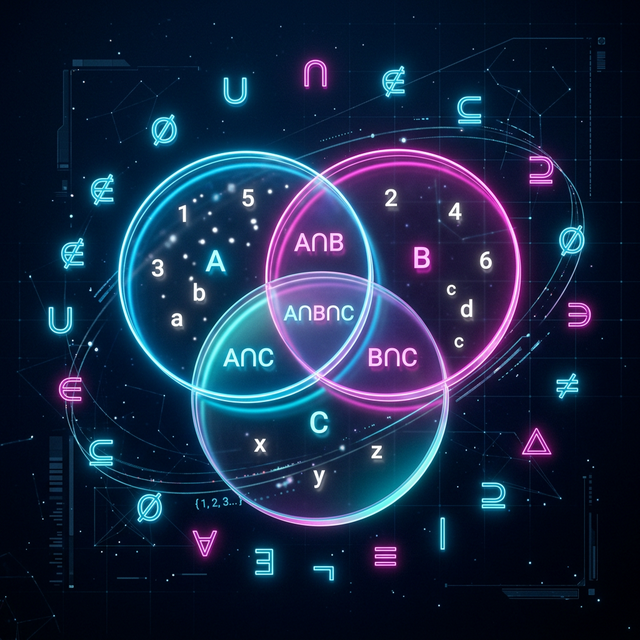
5. Venn Diagrams
Venn diagrams are geometric representations use to illustrate the relationships between sets.
- The universal set is usually represented by a rectangle.
- Its subsets are represented by circles within the rectangle.
Common Formulas:
- n(A ∪ B) = n(A) + n(B) - n(A ∩ B)
- If A and B are disjoint, then n(A ∪ B) = n(A) + n(B).
- n(A ∪ B ∪ C) = n(A) + n(B) + n(C) - n(A ∩ B) - n(B ∩ C) - n(A ∩ C) + n(A ∩ B ∩ C)
Comprehensive Exam Strategy (Q&A)
Q1: If n(A) = 3, how many elements are in P(P(A))? Answer:
- n(A) = 3.
- n(P(A)) = 2³ = 8.
- n(P(P(A))) = 2⁸ = 256.
Q2: Find the intersection of A = {x : x is a prime number < 10} and B = {x : x is an even natural number < 10}. Answer:
- A = {2, 3, 5, 7}
- B = {2, 4, 6, 8}
- A ∩ B = {2}.
Q3: Describe {x : x ∈ R, -4 < x ≤ 6} as an interval. Answer: The set can be written as the interval (-4, 6].
Related Revision Notes
- Chapter 2: Relations and Functions
- Chapter 3: Trigonometric Functions
- [External Reference: NCERT Class 11 Math Chapter 1 (Authoritative Source)]
Conclusion
Sets are more than just lists of numbers; they are the building blocks of logical thought in mathematics. By mastering the representations, types, and operations on sets, you gain the clarity needed to tackle more advanced topics like probability and calculus. Keep your Venn diagrams clear and your subsets well-defined!