Complex Numbers and Quadratic Equations Class 11 Math Quick Recall / Short Notes (2026-27)
Ayush (Founder)
Exam Strategist
[!TIP] 🚀 2-Minute Quick Recall Summary (Save for Exam Day)
- Imaginary Unit (i): i = √(-1). i² = -1, i³ = -i, i⁴ = 1.
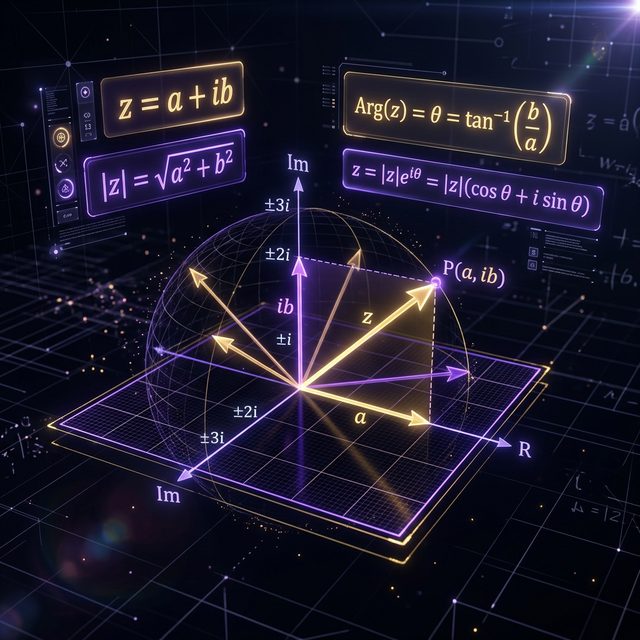
- Complex Number: z = a + ib, where a is Real Part Re(z) and b is Imaginary Part Im(z).
- Conjugate (z̄): z̄ = a - ib.
- Modulus (|z|): |z| = √(a² + b²).
- Multiplicative Inverse: z⁻¹ = z̄ / |z|².
- Quadratic Equations: If D = b² - 4ac < 0, roots are complex: x = (-b ± i√|D|) / 2a. 📥 Download 1-Page Short Notes PDF (Zero-Friction)
Introduction
Complex Numbers expand the real number system by introducing the imaginary unit 'i', enabling the solution of all quadratic equations. Master the Argand plane, modulus, conjugate, and polar representation to solve advanced electrical engineering and rotation problems. This Class 11 Math Chapter 5 summary provides the essential tools for JEE and Board exam success. The real number system is not enough to solve all mathematical problems.
1. The Imaginary Unit (i)
The symbol i was introduced by Euler to solve square roots of negative numbers.
- Powers of i:
- i¹ = i
- i² = -1
- i³ = -i
- i⁴ = 1
- Theorem: For any integer k, i⁴ᵏ = 1, i⁴ᵏ⁺¹ = i, i⁴ᵏ⁺² = -1, i⁴ᵏ⁺³ = -i.
2. Algebra of Complex Numbers
- Addition: (a + ib) + (c + id) = (a + c) + i(b + d).
- Subtraction: (a + ib) - (c + id) = (a - c) + i(b - d).
- Multiplication: (a + ib)(c + id) = (ac - bd) + i(ad + bc).
- Division: (a + ib) / (c + id) = Multiply numerator and denominator by the conjugate (c - id).
3. Modulus and Conjugate
- Conjugate (z̄): The mirror image of z = a + ib in the real axis is z̄ = a - ib.
- Modulus (|z|): The distance of the point (a, b) from the origin is |z| = √(a² + b²).
- Properties:
- |z₁z₂| = |z₁||z₂|
- |z₁/z₂| = |z₁|/|z₂|
- z · z̄ = |z|²
4. The Argand Plane and Polar Representation
A complex number z = a + ib can be represented as a point (a, b) in a plane called the Argand Plane.
- x-axis: Real axis.
- y-axis: Imaginary axis.
- Polar Form: z = r(cos θ + i sin θ), where r = |z| and θ is called the argument of z.
5. Quadratic Equations with Complex Roots
In earlier classes, we said D < 0 means "No real roots." Now, we find complex roots.
- Consider ax² + bx + c = 0.
- If D = b² - 4ac < 0, then the roots are: x = [-b ± i√(4ac - b²)] / 2a.
Comprehensive Exam Strategy (Q&A)
Q1: Find the modulus and conjugate of (1 + i) / (1 - i). Answer:
- Simplify first: Multiply by (1+i)/(1+i).
- (1 + i)² / (1² - i²) = (1 + 2i - 1) / (1 + 1) = 2i / 2 = i.
- Modulus (|i|): √(0² + 1²) = 1.
- Conjugate: -i.
Q2: Find the real values of x and y if (x + iy)(2 - 3i) = 4 + i. Answer:
- 2x - 3ix + 2iy + 3y = 4 + i
- (2x + 3y) + i(2y - 3x) = 4 + i
- Solve: 2x + 3y = 4 and 2y - 3x = 1.
- Solving these equations gives x = 5/13 and y = 14/13.
Q3: Solve √3x² + x + √3 = 0. Answer:
- D = 1² - 4(√3)(√3) = 1 - 12 = -11.
- Roots: x = [-1 ± i√11] / 2√3.
Related Revision Notes
- Chapter 3: Trigonometric Functions
- Chapter 6: Linear Inequalities
- [External Reference: NCERT Class 11 Math Chapter 5 (Authoritative Source)]
Conclusion
Complex numbers expand your mathematical toolkit to include rotation and two-dimensional numbers. By mastering the Argand plane and the algebra of 'i', you prepare yourself for advanced topics in physics and engineering. Remember, a complex number is just a vector in a different language!