Binomial Theorem Class 11 Math Quick Recall / Short Notes
Ayush (Founder)
Exam Strategist
[!TIP] 🚀 2-Minute Quick Recall Summary (Save for Exam Day)
- Binomial Expression: An algebraic expression consisting of two terms.
- Binomial Theorem: (a + b)ⁿ = ⁿC₀ aⁿ + ⁿC₁ aⁿ⁻¹b + ⁿC₂ aⁿ⁻²b² + ... + ⁿCₙ bⁿ.
- Number of Terms: Total terms in expansion of (a + b)ⁿ is (n + 1).
- General Term (Tᵣ₊₁): ⁿCᵣ aⁿ⁻ʳ bʳ.
- Middle Term(s):
- If n is even: T₍ₙ/₂ + ₁₎ is the middle term.
- If n is odd: T₍₍ₙ+₁₎/₂₎ and T₍₍ₙ+₃₎/₂₎ are two middle terms. 📥 Download 1-Page Short Notes PDF (Zero-Friction)
Introduction
The Binomial Theorem provides an elegant algebraic method for expanding expressions of the form (a + b)ⁿ using Pascal's Triangle and binomial coefficients. Master the General Term formula, Middle Term calculations, and properties of ⁿCᵣ to solve high-degree expansion problems in financial modeling and calculus. This Class 11 Math Chapter 8 guide ensures total mastery for JEE and CBSE assessments. The Binomial Theorem is a powerful tool for expanding expressions of the form (a + b)ⁿ.
1. Binomial Theorem for Positive Integral Index
The expansion of (a + b)ⁿ for any positive integer n is given by: (a + b)ⁿ = ⁿC₀ aⁿ + ⁿC₁ aⁿ⁻¹b + ⁿC₂ aⁿ⁻²b² + ... + ⁿCₙ bⁿ
Crucial Observations:
- Powers of a: Start at n and decrease to 0.
- Powers of b: Start at 0 and increase to n.
- Sum of Indices: In every term, the sum of the indices of a and b is always equal to n.
- Binomial Coefficients: The coefficients ⁿCᵣ are symmetric (ⁿCᵣ = ⁿCₙ₋ᵣ).
2. Pascal's Triangle
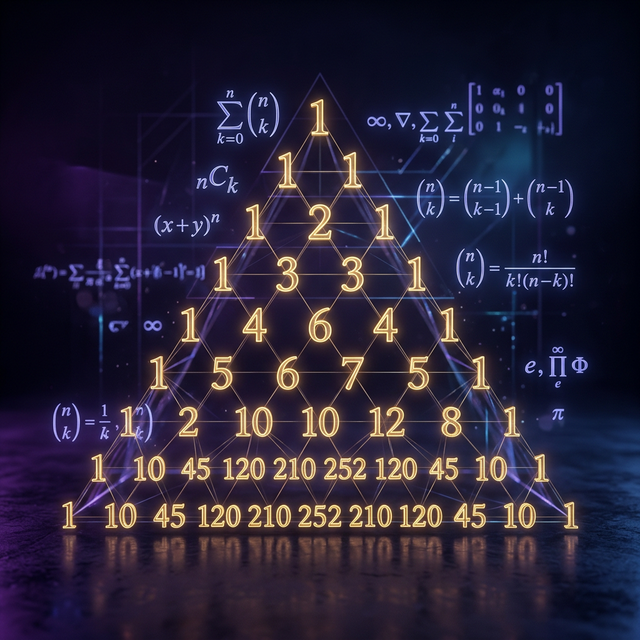
Pascal's Triangle is a geometric arrangement of binomial coefficients.
- The first and last values in each row are 1.
- Every other value is the sum of the two values directly above it.
- This triangle helps quickly find coefficients for smaller values of n without using the ⁿCᵣ formula.
3. General Term and Middle Term
General Term
The (r+1)ᵗʰ term in the expansion of (a + b)ⁿ is called the general term and is denoted by Tᵣ₊₁. Tᵣ₊₁ = ⁿCᵣ aⁿ⁻ʳ bʳ
Middle Term
The middle term depends on whether the index n is even or odd:
- Case I: n is even There is only one middle term: T₍ₙ/₂ + ₁₎.
- Case II: n is odd There are two middle terms: T₍₍ₙ+₁₎/₂₎ and T₍₍ₙ+₃₎/₂₎.
4. Special Expansions
- Expansion of (x + 1)ⁿ: ⁿC₀ xⁿ + ⁿC₁ xⁿ⁻¹ + ⁿC₂ xⁿ⁻² + ... + ⁿCₙ
- Expansion of (1 + x)ⁿ: ⁿC₀ + ⁿC₁ x + ⁿC₂ x² + ... + ⁿCₙ xⁿ
- Expansion of (a - b)ⁿ: The signs of the terms alternate: ⁿC₀ aⁿ - ⁿC₁ aⁿ⁻¹b + ⁿC₂ aⁿ⁻²b² - ...
5. Properties of Binomial Coefficients
- Sum of all coefficients: C₀ + C₁ + C₂ + ... + Cₙ = 2ⁿ.
- Sum of even/odd coefficients: C₀ + C₂ + C₄ + ... = C₁ + C₃ + C₅ + ... = 2ⁿ⁻¹.
- nCr + nCr-1 = (n+1)Cr (Pascal's Rule).
Comprehensive Exam Strategy (Q&A)
Q1: Find the 4th term in the expansion of (x - 2y)¹². Answer:
- Here n = 12, a = x, b = -2y, r+1 = 4 => r = 3.
- T₄ = ¹²C₃ (x)¹²⁻³ (-2y)³
- T₄ = 220 · x⁹ · (-8y³)
- T₄ = -1760 x⁹ y³.
Q2: Find the middle term in the expansion of (x + 3)⁸. Answer:
- n = 8 (even). Middle term = T₍₈/₂ + ₁₎ = T₅.
- T₅ = ⁸C₄ (x)⁸⁻⁴ (3)⁴
- T₅ = 70 · x⁴ · 81
- T₅ = 5670 x⁴.
Q3: Find the coefficient of x⁵ in (x + 3)⁸. Answer:
- General Term Tᵣ₊₁ = ⁸Cᵣ x⁸⁻ʳ (3)ʳ.
- For x⁵, 8 - r = 5 => r = 3.
- Coefficient = ⁸C₃ (3)³ = 56 · 27 = 1512.
Related Revision Notes
- Chapter 7: Permutations and Combinations
- Chapter 9: Sequences and Series
- [External Reference: NCERT Class 11 Math Chapter 8 (Authoritative Source)]
Conclusion
The Binomial Theorem simplifies what could otherwise be a mathematical nightmare. By recognizing the symmetry of Pascal's Triangle and mastering the general term formula, you can find any term in an expansion without writing out the whole series. It's about finding patterns in power! Focus on the relationship between the index and the number of terms, and always watch your signs in (a - b)ⁿ expansions.